

Unlock One Month Free access to ASI:One Pro and Agentverse Premium
October 3, 2026
Ann Arbor, MI, USA
Best Use of Fetch.ai - 1st Prize
$1250
Cash Prize + Internship Interview Opportunity
Best Use of Fetch.ai - 2nd Prize
$750
Cash Prize + Internship Interview Opportunity
Best Use of Fetch.ai - 3rd Prize
$500
Cash Prize + Internship Interview Opportunity
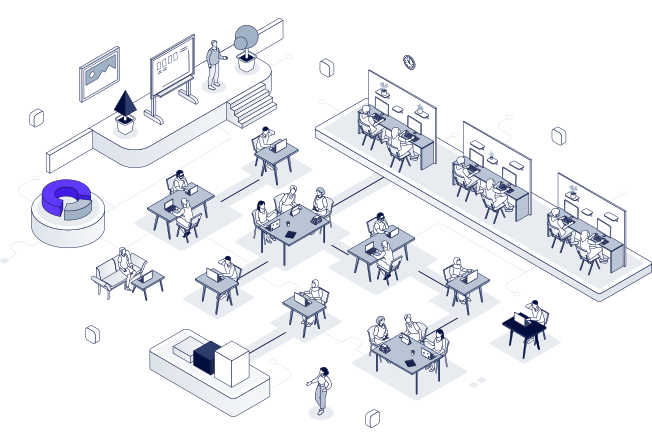
Fetch.ai is your gateway to the agentic economy. It provides a full ecosystem for building, deploying, and discovering AI Agents.
Pillars of the Fetch.ai Ecosystem
Challenge statement
Most AI applications stop at conversation. Your challenge is to build an AI agent that can be discovered through ASI:One, understand a user's intent, and take meaningful action to solve a real-world problem.
Your agent might coordinate services, automate workflows, analyze live information, make recommendations, complete transactions, collaborate with other specialized agents, or execute multi-step tasks. The result should be more than a chatbot or a thin wrapper around an API.
Build a single agent or multi-agent system that:
You may use any framework, including Google ADK, LangGraph, CrewAI, OpenAI Agents SDK, Claude Agent SDK, uAgents, or plain Python.
To be eligible for prizes, your project must:
Projects may receive additional consideration for:
Examples to get you started:
Code


README.mdTo achieve this, include the following badge in your agent’s
README.md

Video
Quick start example
This file can be run on any platform supporting Python, with the necessary install permissions. This example shows two agents communicating with each other using the uAgent python library.
Try it out on Agentverse ↗
from datetime import datetime
from uuid import uuid4
from uagents.setup import fund_agent_if_low
from uagents_core.contrib.protocols.chat import (
   ChatAcknowledgement,
   ChatMessage,
   EndSessionContent,
   StartSessionContent,
   TextContent,
   chat_protocol_spec,
)


agent = Agent()


# Initialize the chat protocol with the standard chat spec
chat_proto = Protocol(spec=chat_protocol_spec)


# Utility function to wrap plain text into a ChatMessage
def create_text_chat(text: str, end_session: bool = False) -> ChatMessage:
    content = [TextContent(type="text", text=text)]
        return ChatMessage(
        timestamp=datetime.utcnow(),
        msg_id=uuid4(),
        content=content,
        )


# Handle incoming chat messages
@chat_proto.on_message(ChatMessage)
async def handle_message(ctx: Context, sender: str, msg: ChatMessage):
   ctx.logger.info(f"Received message from {sender}")

   # Always send back an acknowledgement when a message is received
   await ctx.send(sender, ChatAcknowledgement(timestamp=datetime.utcnow(), acknowledged_msg_id=msg.msg_id))


   # Process each content item inside the chat message
   for item in msg.content:
       # Marks the start of a chat session
       if isinstance(item, StartSessionContent):
           ctx.logger.info(f"Session started with {sender}")

       # Handles plain text messages (from another agent or ASI:One)
       elif isinstance(item, TextContent):
           ctx.logger.info(f"Text message from {sender}: {item.text}")
           #Add your logic
           # Example: respond with a message describing the result of a completed task
           response_message = create_text_chat("Hello from Agent")
           await ctx.send(sender, response_message)


       # Marks the end of a chat session
       elif isinstance(item, EndSessionContent):
           ctx.logger.info(f"Session ended with {sender}")
       # Catches anything unexpected
       else:
           ctx.logger.info(f"Received unexpected content type from {sender}")


# Handle acknowledgements for messages this agent has sent out
@chat_proto.on_message(ChatAcknowledgement)
async def handle_acknowledgement(ctx: Context, sender: str, msg: ChatAcknowledgement):
   ctx.logger.info(f"Received acknowledgement from {sender} for message {msg.acknowledged_msg_id}")


# Include the chat protocol and publish the manifest to Agentverse
agent.include(chat_proto, publish_manifest=True)


if __name__ == "__main__":
    agent.run()
Agentverse MCP Server
Learn how to deploy your first agent on Agentverse with Claude Desktop in Under 5 Minutes
Agentverse MCP (Full Server)
Client connection URL: https://mcp.agentverse.ai/sse
Agentverse MCP-Lite
Client connection URL: https://mcp-lite.agentverse.ai/mcp
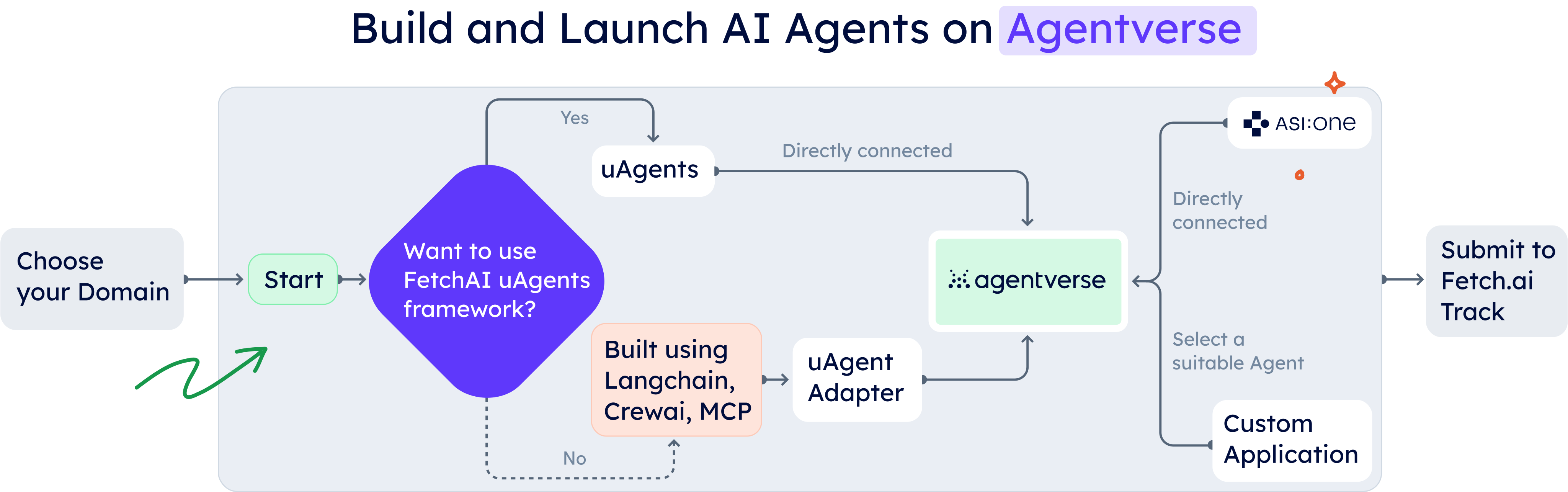
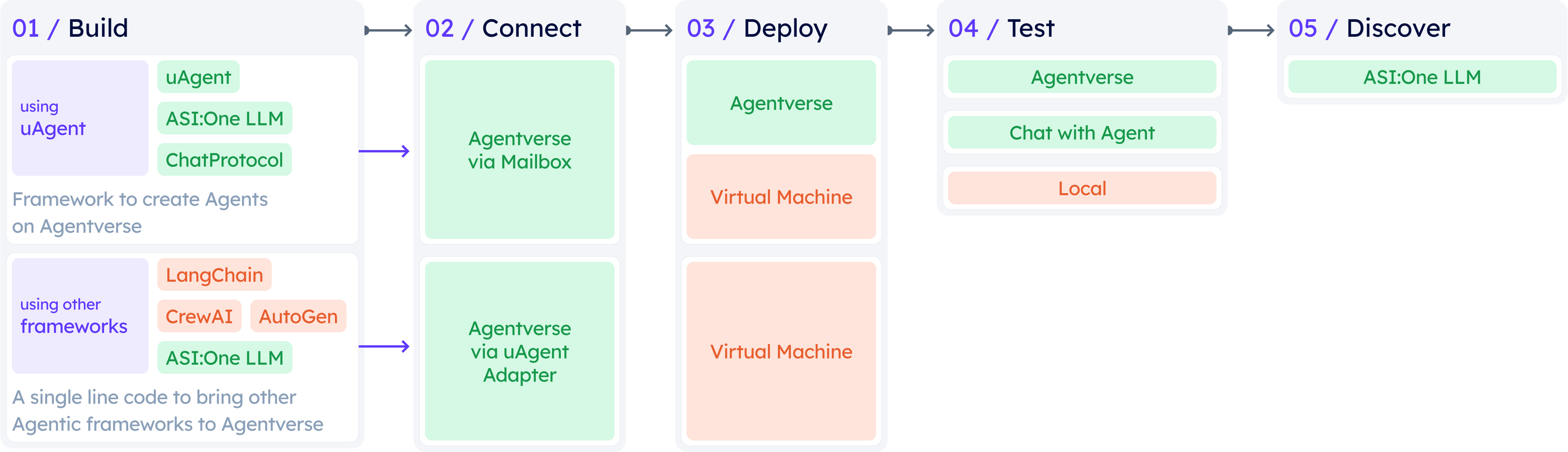
Tool Stack
Judging Criteria
Functionality & Technical Implementation (25%)
Use of Fetch.ai Technology (20%)
Innovation & Creativity (20%)
Real-World Impact & Usefulness (20%)
User Experience & Presentation (15%)
